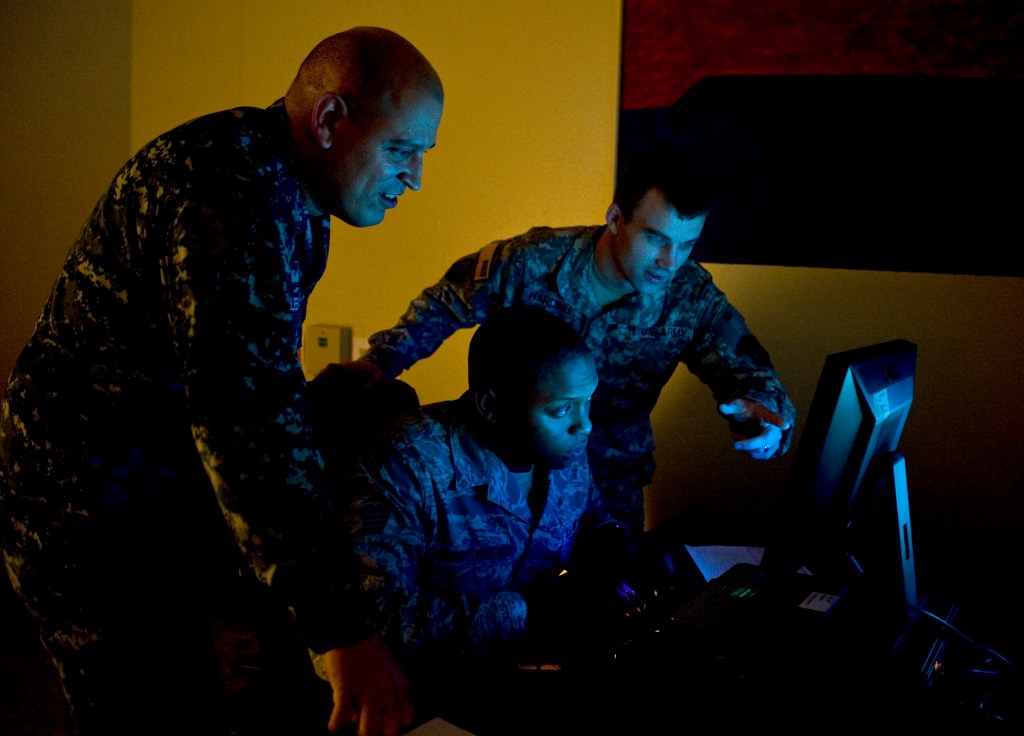
To take on changing types of enemies and evolving forms of warfare, Defense Department officials are moving ahead with at least three major joint training programs in the fiscal 2017 budget request as part of a broader redirection of resources to cyber.
In the budget documents released Feb. 9, Pentagon officials make clear their focus on full-spectrum operations, improved lethality and the next generation of military operations – all of which include cyber as a major aspect. To do that, they must train forces accordingly.
“The Department is taking the following steps in the President’s Budget submission to develop and protect key capability areas, including…continuing to invest in new and expanded cyber capabilities and forces to operate and defend DoD’s networks; enhance DoD’s ability to conduct cyberspace operations; support military operations worldwide; and counter cyber-attacks against the United States,” budget documents state.
Those steps involve several training exercises authorized for 2017 as part of the Combatant Commander Exercise Engagement and Training Transformation (CE2T2) program, funded at more than $150 million in the budget. The exercises stretch across combatant commands, including at U.S. Transportation Command and at U.S. Strategic Command.
In the new Ultimate Guardian exercise, TRANSCOM will link with U.S. Pacific Command capabilities to “assess TRANSCOM, its transportation component commands and subordinate commands’ readiness for defensive cyberspace operations at the strategic, operational, and tactical levels. The exercise will involve detection, reporting, mitigation, recovery processes and procedures, and exploring command and control relationships with supporting cyber mission forces,” the documents note.
STRATCOM will continue to undergo two existing annual joint training exercises. Cyber Guard will present participants with a “whole of nation” cyberspace training exercise focused on “responding rapidly to an effective domestic cyber-attack, catastrophic natural or man-made cyberspace disruption.” Another exercise, Cyber Flag, will fuse “offensive and defensive cyberspace operations with DoD full-spectrum combined arms operations against capable and thinking adversaries in a realistic virtual environment.”
The cyber training programs are just a small slice of the $7 billion budgeted for cyber in 2017, and almost $35 billion over the next five years, “to improve DoD’s network defenses, build more training ranges for our cyber warriors and also develop cyber tools and infrastructure needed to provide offensive cyber options,” Defense Secretary Ash Carter said in a Feb. 2 budget preview in Washington.