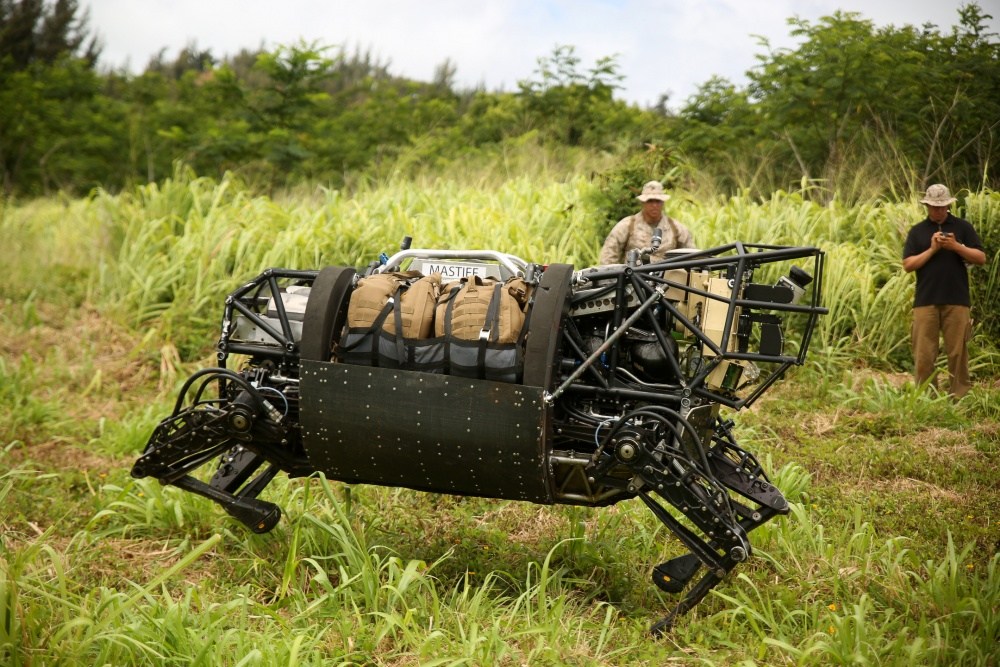
The United States Marine Corps is considering using remotely piloted and autonomous vehicles as a solution for a classic warfare dilemma.
Troops routinely carry massive amounts of weight to and from the battlefield. One study found that a typical infantry assault load, which can include kettlebell-sized batteries to bulky body armor, varies anywhere from 97 to 135 pounds. These overbearing loads can lead to injuries, logistical constraints and lapses in combat effectiveness.
Today, the amount of weight troops are asked to carry continues to grow, while their ability to carry that load does not.
The Marine Corps Rapid Capabilities Office posted a request for information Nov. 15, notifying industry of its interest in “unmanned vehicle technologies to displace the load currently carried by Infantry Marines at the squad level.”
According to the posting, the MCRCO is primarily interested in systems capable of maneuvering alongside a foot-mobile squad of 12 Marines from the assembly area to the objective area. The autonomous systems would leverage artificial intelligence to “maintain accurate geo-location information for navigation in a contested/GPS-denied environment.” The post also notes a “significant interest” in systems capable of conducting intra-squad resupply missions.
“Capabilities of interest include ground vehicles with tele-operation capability, robotic applique capabilities on existing systems, and fully autonomous operation,” the post reads.
The performance requirements for such a system include the ability to operate on unimproved road and off-road terrains, with a capability of carrying a minimum of 500 pounds on unimproved roads and up to 100 pounds off-road. The robotic backpack would also need to be able to maintain 3.5 mph with a full combat load in all terrain environments.
The Defense Advanced Research Projects Agency had a program in 2012 called Legged Squad Support System (LS3), which sought to develop semi-autonomous legged robots to be integrated with a squad. The machine that was developed from LS3 — through a $32 million contract between DARPA and Boston Dynamics — was ultimately shelved due to noise concerns.