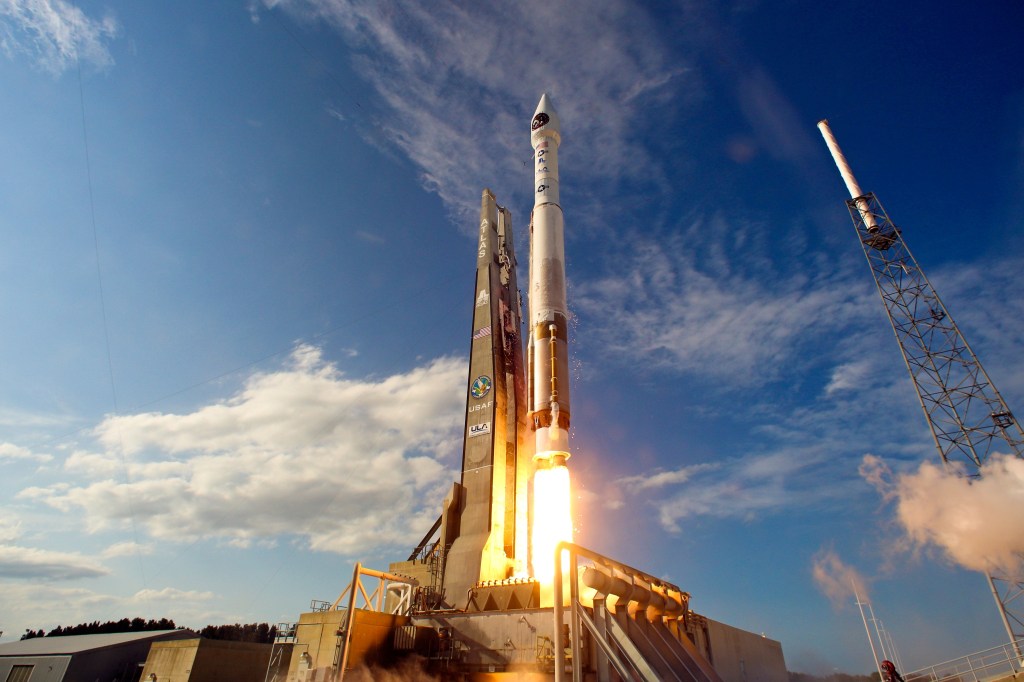
The newest missile warning satellite was successfully launched into orbit Jan. 20.
The launch of Space Based Infrared System (SBIRS) GEO Flight 3 took place from Cape Canaveral after a planned Jan. 19 launch was delayed because of a sensor glitch. The satellite, carried aboard a United Launch Alliance Atlas V, is now responding to ground commands.
“The satellite will begin transitioning to its final location in geosynchronous orbit, approximately 22,000 miles above the Earth,” a Lockheed Martin announcement stated. “There, the satellite’s solar arrays, light shade and antennas will be deployed to begin early on-orbit testing.”
“The next satellite, GEO Flight 4, will undergo final assembly, integration and test prior to its planned 2017 launch,” Lockheed Martin said. “SBIRS GEO-5 and GEO-6, which are currently in production, incorporate a new common spacecraft bus, the modernized A2100, to dramatically reduce costs and cycle times while increasing the potential to incorporate future, modernized sensor suites.”